AJD wrote a personal history of the Quick family which is reproduced here. The Quick ancestry described by JLQ is also analysed and criticised by AJD. There are 60 or more pages so it is divided into chapters for you to read at your leisure. The contents can be searched to access particular content
- Introduction
- JLQ leaves home and starts his dynasty
- The family of JLQ
- Holidays in Hove
- Memories of Christmas
- The passing of JLQ
- Herbert Cottam Quick
- Learning bridge
- Herbert Quick remarried
- The Ancestry of JLQ
- The Distaff Side
It can be readily perceived that the survival of the slender Duggan line throughout the greater parts of the 19th and 20th centuries depended to a large extent upon two women of exceptional character and determination, Dora Duggan (nee Canty, d. Charley) and Margaret Duggan, whose lives spanned 140 years of wars, famine, pestilence and social upheaval.. However, while the Cantys followed the archetype of an Irish famine survivalist group, Margaret’s family, although no strangers to hardship and persecution, were English to the core and from middle of the 19th century, at any rate, strong adherence to the middle class way of life, with its ingrained respect of authority, pursuit of thrift, application to hard work and unswerving acceptance of religious doctrine. In the case of the Quicks, the religion was, of course, Catholicism and there was a long and no doubt correct family tradition of recusancy and even martyrdom from which it successfully endured in 19th century, not only more or less unscathed, but with a dedicated devotion to the church and a sprinkling of priests and nuns throughout its extensive family tree.
The pivot for any examination of the Quicks as we know them is the personality of Margaret’s father, Joseph Lewis. Hereafter known as JLQ. he was born in Northgate, Blackburn on the 15th of February. 1849 son of Robert and Sarah (nee Cottam). He was baptised in the St Albans Church, his godparents being Joseph Bourne and Mary Cottam, a younger sister of his mother. The association with the Cottam family lasted for the whole of his life. They, like the Quicks, had a long history of recusancy and Joseph came to revere them more than he did his own ancestors. The Cottams indeed were a family worthy of study in themselves. And as they exerted so strong an influence over Joseph, some detail is given of them in what follows.
Robert and Sarah had six more children, the last of which was born a few months before Sarah’s death on the 8th of December 1866 when Joseph was seventeen years old. The loss of his mother profoundly affected him. His father remarried and his stepmother made his life unbearable. He ran away from home and went to live with his paternal grandfather, George. Joseph’s break with his father was probably permanent, in all JLQ’s records there is no mention of his father’s death or even of the name of his stepmother. His gratitude to his grandfather on the other hand, was warmly recorded on the back of a portrait photograph of George at the age of 72 which Joseph kept in a brown oval wooden frame until the end of his days.
He was employed in the office of George Quick, a builder of King Street Blackburn and evidently acquired a reputation of meticulous bookkeeping and an impeccable copper-plate handwriting. According to tradition, this talent so impressed one of his grandfather’s business associates that he offered Joseph an accounting post in the city of London with a firm known as Blackburns (by coincidence), and thus JLQ arrived in London on Easter Monday 1871 and began work the same afternoon.
He was probably living in rooms in Islington at about this time, and went on working for Blackburn’s until August 1872. On the 20th of May 1873 he married a beautiful woman, Mary Rose Giles. He was very meticulous about his holidays, which he invariably took in June and September. In 1871 it had been the Isle of Man and then Paris, in 1872 the Isle of Wight But in 1873 he simply recorded “at home a week in May”.
On the 16th of February, 1874 he began work with the West Indian and Panama Cable Company and never changed his employer again. He rose to the position of chief accountant, made a small fortune on the stock exchange and is said to have worked with many famous people, including the architect Lutyens, while he was building Delhi. In some ways, the achievements of JLQ were the highest point to which the Quick family had risen in recorded history. For most of his days, his word was law. In the 1920s his grand-children looked upon him as a kind of deity.
Soon his children began to arrive. Those who knew this generation would say that JLQ was not founding a family or even a dyntasty, but a veritable pantheon of heroes and heroes. Every one of them who survived to adulthood (and incredibly, out of nine out of 11 did so) made some impact upon the rest of mankind. Some divested themselves of religion, while others tried to become saints. Whatever they were, they were convinced their causes were right. They were immensely charitable, yet often lacking in charity. Everything was done, for good or for ill, at full throttle. They moved like lightning. They talked until the very language screamed for mercy. They compelled from their long suffering quietly spoken spouses, not only love and admiration, but life long bewilderment. Every trivial domestic problem was treated as a turning point in history. Every birth, marriage or death as a landmark in the evolution of society. Clever and restless their adult lives seem dedicated to the bursting of their childhood repressions; no matter where they were, the room, the house, the church, the office, echoed with their vitality. Moreover, as a single generation, the sons and daughters of JLQ graced the Earth for a long time; from the birth of his first son, Charles, to the death of his daughter, Bernadette, took 100 years and 27 days. At her death on the 17th of November 1975 at least 19 of JLQ’s grandchildren were alive. The youngest (Teresa Fallon), being about 50 years old. His great grandchildren at that time may have totalled over 90.
Once married, JLQ lost little time in laying the foundations of this prodigious tribe. Charles Sebastian arrived on the 20th of October 1875 to be followed by a brother, Herbert Cottam [the affiliation carried by his second name ] on the 20th of April 1877. Joseph, anticipating the deluge once the floodgates had been opened, moved to a large house called Victoria Villas in Victoria Road. (now Vale Road) Upton (now Forest Gate) in June 1877. Infants duly arrived in 1879, 1880 and 1882, after which he took his wife for two months holiday at Southend. In April 1883 he moved again, to number three Victoria Road, and in 1884 took his holidays in Germany and Belgium alone, his wife was preparing for the next lap; Elizabeth was born in October of that year, Joseph in 1885 and four more daughters appeared in 1887, 1888, 1889 and 1890. My mother Margaret being the last in line. JLQ took himself to Brighton “for baths alone”. His wife had given him 11 children in 15 years; all but two had survived, and not another was to go for thirty-three years. As his children began to grow up, he moved into a four storey villa in Ham Park Road.
The household, replete with nurse maids and other servants was run upon lines similar to those of the Barretts of Wimpole Street, except that in the case of JLQ, much was centred upon the Catholic Church. He joined the St Vincent de Paul Society in 1877, practically on moving to Forest Gate, and played a most important part in the purchase of land for the Franciscan church and Friary of St Anthony in Khedive Road (now St. Antony’s Road). There was still much ill feeling towards Catholics in those days and when the development was publicly proposed and objections invited, JLQ buried a crucifix on the site until the period of grace expired. Later, he became president of the SVP and was decorated by the Pope and became one of the best known Catholics in South West Essex.
His wife, on the other hand, was permanently ill in bed, and even the children were seldom allowed to see her, with the exception of her eldest daughter, Mary (Mamie), who maintained that she “stank”. She was probably exhausted by childbearing. She died of a ruptured appendix on the 28th of October 1909.
By this time, the family had taken on a recognisable pattern. There had been the inevitable Victorian spillage, with little Winifred dead inside two years from a perambulator accident in West Ham Park (another story to be told) and Agnes lasting only 17 days. The household, too, was clearly not to the liking of sons. Charles, who had been sent away to St Francis Xavier School at 14, married at the turn of the century and presented JLQ with his first grandson on the 24th of October 1900. Thereafter, history repeated itself. He broke off relationships with his father and little was heard from him again.
Herbert Cottam, meanwhile, had qualified in accountancy and was later to set up the well-known practise of Quick and Grimes. He was plagued with bad eyesight. He married Agnes Mojer, a gentle and lovely woman older than himself, and went to live on the Woodgrange Estate at 43 Osborne Road, a large dark and uncomfortable double-fronted house in which he lived for the rest of his married life with his wife and her sister Maggie.
By 1909 Francis, too, had become an accountant, married and gone to live in Norwood. Herbert had no children but Francis kept Quick traditions going with 6 sons. Much had rested upon Mamie, the slender dynamo who had given much of her early life to her mother and her sisters. It is said that she dearly wished to study languages, but her father and the times were against her. Certainly no politician or lecturer could rival her command of English. To the end of her long life, she spoke at immense speed with perfect grammar and utter fluency for hours on end. (As if in compensation, her granddaughter, Collette nee Alcock, is an exceptional linguist). Mamie was married to Louis Withnall before her mother died, and producing a large family of her own at 89 Hampton Rd, not far from her brother, Herbert.
Thus, upon the death of his wife, who was greatly mourned by her children, if not by her husband, JLQ retained only his youngest son, Joseph, and his four youngest daughters, Elizabeth, Bernadette, Gertrude and Margaret.
Joseph had for a long time been bed-ridden by osteomyelitis of the tibia. He was submerged by the personalities of his sisters who tended him with loving care. After his marriage to Ethel Nicolle, he went to live in the West Country. He proved to be long-lived in the end, but contact him with him was sporadic. His appearances were rare and his exchange of letters with his sisters resembled kisses in the darkness of time. He alone of that generation was content to be a back-seat driver, never at the wheel.
Elizabeth on the other hand, drove her chariot of chronic invalidism at full tilt from first to last, taking with her anyone who cared for that kind of ride. She was an exquisite, frail Victorian child and in other than a middle class home, she would not have lasted a fortnight in the 1890s. Being excused almost all of the rigours of the household, she was able to devote herself to painting poetry, petite-point and prayer in all of which she excelled. It must be said that as she grew up, she employed these talents to the full in a profusion of charitable causes. No-one asked her for help in vain, with the possible exception of her husband, Francis Donovan, a blunt and somewhat rough-necked businessman who worshipped the ground she walked on and did his best to master the arts of the Charleston and Mahjong together with other social graces which might have prevailed at the time. All this for the sake of Elizabeth, without reward and without much thanks either, as Elizabeth was a chip off the old block.

The younger trio of JLQ ‘s daughters were schooled at the Ursuline Convent of St Angela in Upton Lane and the earlier exploits of Bernadette were largely concerned with the defiance of authority at that establishment.
Her role in JLQs household is a matter for conjecture. Greek must have met Greek on many an occasion. And the old master must have heaved a sigh of relief when Alfred Fallon, the tall, handsome, impeccably dressed and beautifully spoken son of the professor of classics at Malta University, asked for Bernadette’s hand in marriage. He did not have to ask twice.
By 1909 Gertrude and Margaret in their late teens were shouldering the kind of tasks that were, so to speak, between stairs. An authoritative, busy father and an ailing mother above, and a platoon of domestic helps down below, left a vacuum of unfulfilled domestic activity, which was theirs to discharge. Their thoughts and intentions advanced for young ladies of the time, turned towards nursing and Margaret’s turned also towards a school teacher by the name Thomas Duggan, as has been told.
After the death of his wife, JLQ remarried, choosing a tiny, robust and eminently down-to-earth woman, known only to me as Auntie Annie. She undoubtedly loved and respected her husband and sustained him generously throughout the rest of his life. But she stood no nonsense. The Victorian days of Ham Park Road were over. The Quick company with its new recruit moved to 41 Windsor Road on the Woodgrange estate alongside Herbert Cottam and “Mamie” Withnall.

The contribution of this household during the First World War was largely concerned with the Belgian Red Cross. Among the numerous refugees which JLQ harboured under his roof was a sickly young man. Louis Lembrechts, who died there on the 14th of May, 1917 having been nursed for a long time by the womenfolk. Louis’ death was caused by tuberculosis and this may have been of significance. Gertrude took up nursing professionally at Whipps Cross Hospital. Margaret joined her for a little while, but a chronic sinus infection rendered her unsuitable for a formal career. She had much to do, for her sister, Mamie not far away, welcomed a helping hand with her growing youngsters, one of whom evidently had a peculiar flair for arson and other kinds of mischief.
The war ended, but it was not only the cessation of gunfire and the ending of celebrations which brought stillness to the house at Windsor Road. By 1920 only Gertrude in her off duty hours came to her father and in 1922 on the 31st of October, tuberculosis struck her down. JLQ and his Annie and one or two servants had come to the autumn of his life. The branches of his tree were separating, the leaves of his paternal mantle were being quietly shed. But his roots lay strong and deep. He took 11 more years to fall.
It was during that span of time that I derived my personal experience of him, for I was his youngest grandson and lived in Stratford little more than a mile away. In those days, I obtained vivid impressions too, of some of his children, my aunts and uncles (but then did any Quick ever fail to make a vivid impression?). The Hampton Road household of my aunt, Mamie, teeming (so it seemed) with older cousins, sizzled with life, a hot-bed of Quick-like energy with triumph following disaster and good fortune succeeded by calamity from one minute to the next. Rock-like amid the maelstrom stood the distinguished figure of Mamie’s darling Louis. To me, it always seemed that he had three major domestic preoccupations, repelling burglars, killing flies and boiling food for his chickens. Activities which either by night or day, occasionally ran crosswise to the mainstream of his family’s concerns.

The childless Aunt Elizabeth conducted her household in a more rarefied atmosphere. She and my uncle, Frank Donovan, lived in a modern villa called “Lourdes” at Hove in Sussex. She insisted on Hove, which was evidently a rung or two above the residential stratum of Brighton, where many years before her father had “taken baths, alone”. It seemed to me that at some earlier stage in the marriage lottery, she should have changed partners with Aunt Mamie, as it was, Uncle Frank Donovan existed under a cloud of perennial disapprobation. On a dilapidated gramophone with wooden doors and a large brown horn, he would play his favourite record of “The Two Black Crows” winding the clockwork all the while as Elizabeth, with eyes aloft, yearned for the spirit of Ketleby to beckon her into “The Monastery Garden”. The appearance of a half pint beer bottle on Uncle Frank’s dinner table was the signal for yet another novena to be set in motion countering the temptation of Mr Charrington with 1000 days of purgatorial indulgence.
But the bits that I loved most were the car rides. Uncle Frank Donovan had a blue Morris Oxford, one station above a Morris Cowley with the registration number MM 4890. I was made to remember this number by a complicated pneumonic, beginning with Mother Mary and ending with the Psalms, however I remember the number. There were no seatbelts in those days, so the journey would begin with prayers to St Christopher and other saints for the mortal deliverance of passengers and crew in that order before Uncle Frank Donovan, blind in one eye, let in the clutch and, peering through a windscreen festooned with holy pictures and statues of the Virgin, made his way into the traffic stream. There is nothing like religion to excite the spirit of adventure in the heart of a young boy. We crusaded aloft among the infidels of South Downs, defied Satan himself on the rim of Devil’s Punch Bowl and coasted home through the pagan shrines of Shoreham to find sanctuary again at “Lourdes” 43 Mansfield Road, Hove, Sussex.
As I grew up a little, the spiritual allure of the south coast became somewhat less attractive. Aunt Elizabeth was having visions and rose petals were being found on the floor of the church at a time when no roses were meant to be in bloom. (It was far cry from her sister Mamie’s problems, with eight children, 20 chickens, a million flies and a threatened burglary every night.)
The vapours and chlorotic anaemia of her Victorian years had given way to the sterner stuff of diabetes, thyrotoxicosis and auricular fibrillation, but still she soldiered on with daily communion, bridge parties and other good works “Uncle Frank Donovan” notwithstanding. (He went to Chicago at the height of Capone’s domination, but returned safely to “Lourdes”, perhaps on account of his wife’s prayers rather than his own inclinations.) The annual invitations to a fortnight’s holiday by the sea to her nieces and nephews (like me), generous, welcoming and homely though they were, became tempered by her deep obsession with the actions of everybody’s bowels. They found elsewhere to go. But my last impression of Aunt Elizabeth was not related to the toilet seat, but to the settee on which she lay, her arms and legs outstretched, mimicking the torture of the rack. That was the end of my last jolly holiday at Hove.
JLQ, mellowing with the passage of the years, stood up well to the patriarchal test of Christmas Day. Even though December the 25th 1932 was the first day on which I wore long trousers I did not then, or at any time before, realise the delicate interplay of those forthright, liberated and outspoken personalities assembled in the parlour and around the dinner table 12 hours after Midnight Mass. Year after year, the ageing helmsman steered his uninterrupted course. This youngest grandson indulged his physical whims with accommodating and affectionate aunts, uncles, priests and nuns in the late afternoon and was shortly thereafter whisked off to bed by a servant to enjoy a reading of the Tiger Tim’s annual before falling asleep in the vast security of 41 Windsor Road.
By tradition, Boxing Day was spent at Auntie Mamie’s in Hampton Road, a massive bonanza with people nearly all as young as I, to whom I could almost talk without being heard, with whom I sensed some similarity of relationship with the fountain head of the day before. Chickens were slaughtered in the back garden, flies were smashed to smithereens on window panes, eccentric neighbours were made drunk on sherry, cousins rhapsodized with gorgeous counterparts, decorations caught fire and Uncle Louis, fly swat in hand, keeping everything under control with seeming powers of life or death enveloped in a cloud of cigar smoke and brandy fumes.
Yet these annual spasms taught me far less about JLQ than the sporadic, isolated visitations which I ventured to make on my own. One could stand alone in the great hallway with a 7 foot grandfather clock monitoring one’s life on the left and a 6 foot painting of Titus’ destruction of Jerusalem on the right while a servant whose eyes glowed red in the dark, warned you that Mr Quick was not at home. At some other time, if you were lucky, you would be received into the presence, given a short lecture on the etchings of Augustus John and rewarded for your patience with a gold half sovereign. But everywhere about that house was a stillness, a temporary petrification of things as though time was in cold storage, waiting for the thaw which would allow it to flow again.

In those days I went practically everywhere on roller skates, but before I had traversed the front garden path of 41 Windsor Road on a mere two expert silenced wheels, the door would open and the servant with eyes that glowed red in the dark would point with a majestical flourish to the tradesman’s entrance. There, divested of skates, I was permitted to announce my business. I just wanted to see my Grandad. After all, he was the only grandparent I ever knew and I would never leave him in his strange, silent over-furnished darkened room where time stood still, without taking with me a little of his massive self-belief to store away for the future.
The harsh winter of 1932-33 with its accompanying epidemic of influenza, took a heavy toll of the weak and the aged. JLQ, in his large, underheated house, survived, but took increasingly to bed. His final incipient decline, noted by his wife and daughters, went unmarked by his youngest grandson until early May. The hurried conversations and the increasing sense of urgency and concern about the family visits to Windsor Road heralded the end of an era. JLQ died on the 12th of May, 1933. Although I was in his house at the time, my recollections of the event are strangely vague. I was left largely in the care of the servants as the climax approached and I was somewhat apprehensive that the entire family was going to forget my birthday, which was due on the day following. My grandfather died in the early evening and only then was I given something to do. JLQ’s house had no telephone and I was commissioned to carry the news of his death to the Franciscan Friary at Stratford. Windsor Road and Earlham Grove provided excellent asphalt surfaces for roller skating and the assignment was accomplished in record time. His body was interred in St Patricks Cemetery in grave A 14 1089, in which lay those of his first wife and my god-mother Gertrude, his daughter. The aftermath was a prolonged and complicated affair leading inexorably to the dissolution of everything in the ancestral home. JLQ’s second wife, Annie, moved to a flat in Bognor and number 41 was put on the market. It was slow to sell and in the middle of the following winter I visited it with my father. As I wandered through the dark, empty rooms it seemed like a house of ghosts. I went into the large kitchen and found water cascading out of the massive Dover stove from a burst hot water tank at the back. My father dealt with it and as we came away we looked for the last time at my grandfathers long sitting room. On the mantlepiece stood the only object left in the house – the skeleton clock under its glass dome waiting to be rewound. I have it still. (Now in the possession of the youngest son of AJD).
A few years later Annie moved to a convent in Hillingdon near Uxbridge. She died during the Second World War aged 78 years on the first of February 1940 and lies in a grave next to her husband.
To chronicle the family history of JLQ ‘s immediate descendants would present an almost impossible undertaking. His death marks the moment of historical fragmentation, from which point onwards a member or members of each line must take up their individual stories and relate them, if they are so inclined, to the source from which they sprang. Yet, in the case of my uncle, Herbert Cottam, the second son of JLQ, this will not be possible, for he left no line at all. He seemed in so many ways to epitomise what can only be described as “Quick-ness” that to leave his record completely unfulfilled would be ungracious, churlish even, in a nephew who saw in him so much to admire.
I never remembered him as a young man, simply because he was already 43 when I was born and was certainly over fifty before I began to recognise and remember him as a person rather than a member of the hierarchy of my mother’s family. According to her, however, he hadn’t changed in his outward appearance since he was 25 and indeed, he remained practically unaltered during all the years that I knew him. He was well over six feet tall, thin as a rake, but not quite absolutely bald. He was very round shouldered with long loose arms, tapered hands and large feet. His head was egg shaped, save for the prominent chin, a conspicuous feature of nearly every Quick. He was myopic which obliged him to crane forward slightly and peer at his surroundings through pince-nez spectacles. These always fitted far too tightly across the bridge of his very prominent nose which became of a deeper red as each day wore on, not only because of the mechanical constriction of its blood supply, but also on account of the consumption of large quantities of whiskey combined with perpetual blowing of the organ into enormous handkerchiefs. When he did not blow, he sniffed. He seemed always to be suffering from an incurable cold.
During the daytime at any rate, he invariably dressed in the same way. at a superficial glance, he seemed to have climbed straight out of the rag bag but a closer inspection would quickly betray the fine cloth of the dark loose fitting jacket, the splendid cut of the long narrow trousers that never saw a cleaners from one year to the next. The eternal bow tie was always askew, the high stiff white collar was winged if only to accommodate the massive Adams Apple protruding forwards from the lean neck forever rising and falling between the highly starched lappets. Almost the whole of this sartorial array, save for the back, was covered in cigarette ash. And yet, detail after unprepossessing detail, my Uncle Bert emerged as the complete fearful, fearless professional accountant. Perhaps by making himself a music-hall imitation of his father, Herbert Cottam somehow got the better of him.
But there was no imitativeness about the voice of my uncle. No larynx in the world, but his could have created such a sound. To say that it was a perfectly integrated combination of a growl and a bellow is to fall far short of the mark. To say that his “hello” on the telephone was like gravel falling from the back of the lorry is merely to relate a subjective experience. Just let it be said that he alone in 5 words could stop his sister, my Auntie Mamie, in full flood.
I suppose that I was about 12 years old when my father realised that I had something of a curious, innate ability to play cards and took me, as a juvenile spectator to games of bridge at 43 Osborne Road. My father played of course and my uncle was invariably partnered by his friend Mr Markey. My cousin Herbert Withnall, young though he was, took a hand from time to time. Mystified but relishing my privileged position, I watched and kept very quiet, noticing the play of the cards and taking in the atmosphere of the ill-lit, heavily curtained room and the still concentration of the players punctuated by animated conversation over the play of the hand or the fall of the cards.
The wife of my uncle was named Agnes, but was always referred to as Poppy. Her sister, Maggie Mojer, also lived at number 43. They were devoted to each other, although one would hardly have believed that the slender delicate Poppy was so closely related to the short bucksome and business-like women who played such a large part in running the household and acted almost as a governess to her brother-in-law. The influenza epidemic of January 1933 brought down all three of them and on the 16th of the month Poppy died. On that night, my father sat at the bedside of the gravely ill Maggie Mojer who had not been told of her sister’s death. At an early hour in the morning of the next day, she slowly pulled herself up in bed, pointed to the door and said I’m coming Poppy. Within a matter of hours, she too was dead. My father said it was a rather unnerving experience. Uncle Bert recovered from influenza, but was distraught for many weeks afterwards. The family closed their ranks and he was well looked after. His father died four months later and as his executor, Herbert Cottam found plenty to do. The estate was large and complicated and brought him back into touch with many whom he had not seen for years. By the autumn, the card parties at number 43 had been resumed. Sometimes I was allowed to play and even now at the bridge table I can picture the long tapering hand of my uncle collecting the tricks and his unforgettable voice in toning the principles of the game. “No boy, King before the Ace”; “Through strength into weakness”; “Fourth highest from the longest suit”. It was a penny a 100 and he always paid my losses and gave me my winnings and provided an inexorable supply of Idris fizzy lemonade. He was not exactly an ingratiating character, perhaps, but he was a good uncle.
In due course, he remarried, choosing for his second wife, a gentle patient lady known to me as Ethel. Outwardly, she bore a considerable resemblance to the late Maggie Mojer but that, no doubt, was fortuitous. Ethel although of a less dominant nature, had the quality of endurance which, as things turned out, she was to heavily rely on. The house at 43 Osborne Road was sold, and Herbert Cottam, with his new wife, went to live in Windsor Road Wanstead, the very street in which his sister Elizabeth had lived during her early married life as Mrs Donovan before she moved to “Lourdes” in Hove.
My uncle by this time was the senior partner in the accountancy firm of Quick and Grimes. And he was a specialist in income tax problems. Shortly after the Second World War, he was admitted to hospital for an eye operation on account of glaucoma. He was not a cooperative patient. His convalescence was stormy, and he lost one eye and very shortly afterwards, the other. Undeterred, he continued to conduct his business at home. As long as problems could be spoken to him and columns of figures read to him aloud, he could make his decisions and calculations in his head as well as if he were sighted. In all this, he was helped by his partner and by others, particularly. Herbert Withnall and his brother Joe. Horses and football pools were quickly recruited to replace the exciting uncertainties of a pack of cards. His whiskey consumption remained unabated, although he once complained that Ethel was diluting the bottles. She had much to put up with, she had been drinking it herself. She would have been easily forgiven. Finally, she was admitted hospital for an operation on her leg.
I have never been able to understand the arrangements which were made to look after my uncle while his wife was away. I visited him one Saturday morning to find him in a cloud of cigarette smoke listening to a sports commentator on the radio and preparing his bets for the races in the afternoon. The front door was open and the tradesfolk simply walked in and out. The bills being settled from a pile of notes and cash lying on the sideboard. Neighbours dropped in motivated either by goodwill or curiosity or both. My uncle was in a boisterous mood as though conducting and providing the sound effects for some nonstop ballet which involved everyone within a radius of a mile. I assumed that eventually one of the cast would stop and cook him some lunch, so I withdrew having made sure that the available quantities of whiskey and cigarettes would meet his preprandial requirements.
Although my uncle’s way of life was not such as Milton would have adopted, I felt that if a blind man had to live alone, Herbert Cottam was showing the world his way of doing it. Enjoying it into the bargain. My mother, however, insisted that “something had to be done”. Inevitably, in the case of my uncle, disaster struck again.
A lady was appointed as a kind of emergency housekeeper and general factotum with the idea of restoring some kind of order in the house at Windsor Road. After about a week, my mother was telephoned at about 8 o’clock in the morning. “This” said the voice as though introduction was necessary “is Bert”. He then related how he had woken up in the middle of the night to find the new housekeeper sitting on his bed. She was talking gibberish. He tried to calm her down, and after a while she left him. Pandemonium broke loose all over the house. Furniture was pushed about, utensils flying around, water taps turned full on and windows thrown open. Finally, the front door slammed shut and her footsteps died away into the night. My uncle realising that she had unaccountably gone mad was fearful of two things; that she had set the house on fire and that she might decide to return. The endless groping of an unsighted man in a house he could no longer recognise before he could secure the door and telephone his sister hardly bears contemplation. But somehow he did it.
Even in the case of Quicks, there is a limit to what flesh and blood can take and 1955 saw my uncle in declining health. The speculations concerning the nature of his illness would have filled a medical dictionary, but eventually he was taken to hospital, where an exploratory laparotomy was performed and whatever he was suffering from was pronounced incurable. Four days after his return home, his abdomen burst open and the ambulance took him back to the operating theatre. My mother’s account of this leaves no doubt that although he was in extremis, he had not lost his voice. It was his last and greatest ballet performance. He came back to Windsor Road rather the worse for wear but still in good wind and the womenfolk of the family braced themselves for another imbroglio. One of them was reported as saying to my mother “O Mag to think we’ll have to go through all that again”. They did. But the next time my uncle didn’t quite survive, he died on the 18th of June 1956 at the age of seventy nine. He was interred with his first wife, Poppy in Saint Patrick’s cemetery not far from his father’s grave. It was a tribute to him that his loss was felt most by his nieces and nephews. They joked about him of course, as he would have wished. One said that his coffin along its journey left a trail of cigarette ash everywhere it went; another related that the inscription on the headstone runs “Danger. highly inflammable”. It is difficult for ordinary folk to mourn someone who is larger than life but he will be affectionately remembered and kindly spoken of until the end of the century. And few men without direct descendants could be given that guarantee.
The time has now come to set down what is known of the ancestry of JLQ. It will be a task of scholarship rather than of personal recollection. And even in the end, it will be little more than a ghostly scaffolding, half lit, upon which successive stages were erected for real people to perform their daily tasks and to react, either with happiness or with grief, to the events which involved them at the times of their lives.
Most of what they did will never be known. But finally, they gave rise to Joseph Louis Quick and through him to a remarkable generation of men and women such as Herbert Cottom and my mother, Margaret Mary. And numerous others whose like both as individuals and as a family, we shall never see again. Without them, to proceed would be a pointless academic exercise.
There can be no doubt that JLQ spent much time in the study of his ancestors, or rather, in the contemplation of his family tree. He was not always accurate. He even recorded wrongly the date of death his daughter, Gertrude. More unfortunately, he gave no hint of his sources so that detail cheque him becomes a monumental labour. Most of his data probably came from little known parish records. He wrote “first event seems to be the grant of a crest in 1623 by James the first” and this statement is almost certainly without foundation. The crest used by JLQ on his note paper and elsewhere was “a demi-antelope armed, attired, tufted and and maned carrying the motto Vincit Veritas meaning “truth conquers”. In fact, there was little in the way of truth about it. For the device belongs to a large and distinguished family of Quicks in Somerset, of whom at least 100 are extant. None of whom has any genealogical connexion with JLQ whatsoever. He had no legitimate claim to be a member of the landed gentry as his family circumstances will confirm. His father, Robert, about whom very little is known, had seven children by his first wife, Sarah Helen Cottom, of whom JLQ was the first to be born. The first four children were born in Blackburn, the last three in Liverpool. The children were born at six different addresses, which hardly gives the impression of stately home ownership and three of the first six children were dead before the 7th was born. Within 6 months she and her mother followed them to the grave. One would hardly claim that the boyhood of JLQ was spent in salubrious surroundings. It is hardly surprising that after his father remarried, he returned to Blackburn and lived with his grandfather as already described.

His two surviving siblings were Mary Ellen, who became a poor Claire, and his brother Francis thus christened in a repeated attempt by his father to acquire a son of that name. Francis died when he was nearly 27. I have no details of him, but he is the only candidate for the fatherhood of my mother’s two cousins, Robert Quick, a Jesuit and the much-loved Ignatius Quick who lived with his wife Polly in Preston.
Since it is quite certain that George Quick was the father of Robert and the grandfather of JLQ, all that is known of him might as well be set down at once. To write a family history is to launch a ship upon the seas of time; in this case George Quick represents the last point of departure whose latitude and longitude are definitely known.
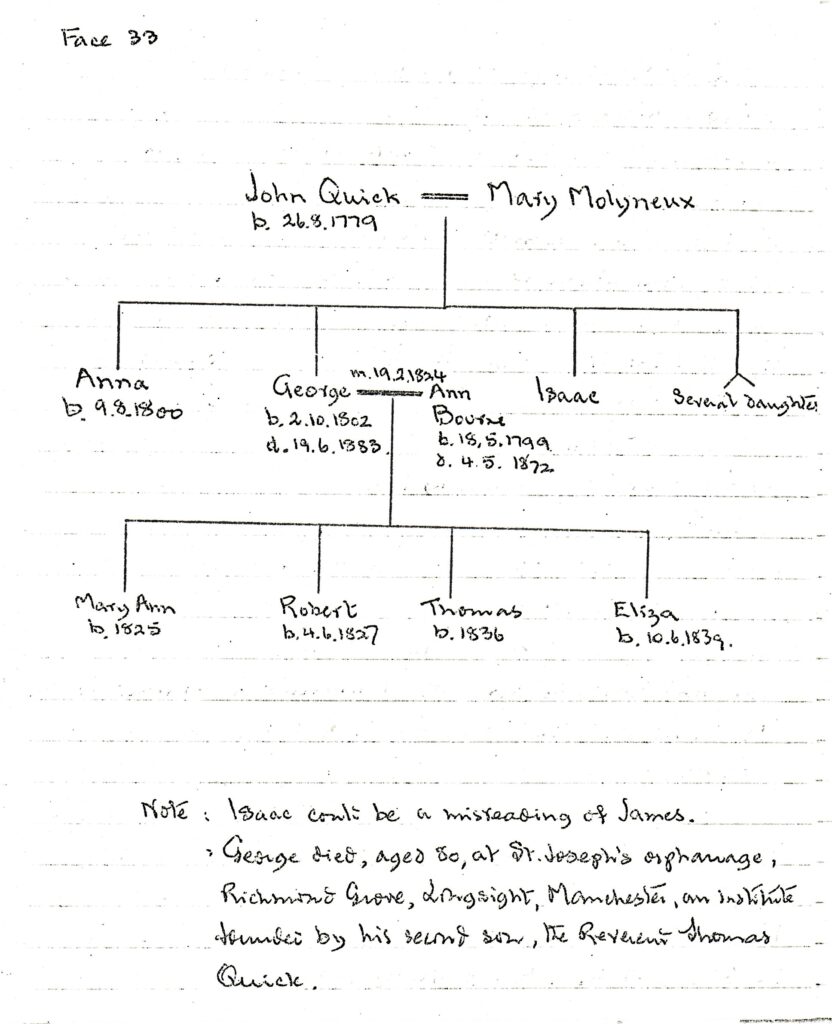
George was the first son and second child of John Quick and his wife Mary Molyneux. He was born at Woolton Magna, near Liverpool on the 2nd of October 1802 or the 9th of October 1803. For about 100 years the Catholics of Woolton had had the service of a Benedictine missionary who resided either there or at Childwall not far away. The Molyneux family provided the chief support for the mission and at one time owned Woolton Hall and 370 acres of land purchased early in the 18th century by one Richard who became the fifth Viscount Molyneux in 1718. (It may have been the Molyneux connection which gave JLQ his ideas; yet I doubt he ever knew that he must have been distantly related to a Viscount.) Richard’s widow Mary nee Brudenell, realising that upon her death the Woolton estate would pass out of Molyneux hands, gave several acres to the Benedictines and helped the monks to build Woolton Priory in Watergate Lane.
All this happened within the lifetime of George Quick’s mother, who was, of course, a distant Molyneux. George was baptised by none other than Dom John Bede Brewer, who lived in Woolton for about 38 years and was chosen president of the English Benedictines in 1799, an office which he held until his death in 1819. It was Dom Brewer who registered George’s birth in 1803. The earlier date comes down from JLQ, who may conceivably have been correct. He records George’s godparents as Francis Webster and Anna Fogg.
George Quick’s siblings are of little account to us. His elder sister Anna was born on the 9th of August 1800 and her godmother was Margaret Hailwood, perhaps a significant name. JLQ records a younger brother to George by name Isaac, strangely enough, and no fewer than six younger, unnamed sisters. Perhaps we meet their descendants every day of our lives. But it is no great matter here. It would be of some interest to know the material condition of their parents, John and Mary, JLQ records no neonatal holocaust such as he witnessed among his own generation. We may take it that the Molyneux and the Benedictines between them saw to it the George Quick could read and write and in due course he, like most men, “put away the things of a child” and got married.
We have seen in the Duggan history that one holds hard down the generations to the family name. But it is the distaff side that holds everything together. The male bricks collapse without the feminine mortar. We already know the influence of Sarah Cottam and Mary Molyneux upon the existence of JLQ and now we meet another, Anne Bourne. George Quick married her at St Ann’s Liverpool on the 19th of February 1824 and shortly afterwards, married her again at the Catholic Priory in Pleasington, near Blackburn. Such double marriages were not at all unusual before Catholic emancipation. The chief interest is that the Bourne marriage brought the Quicks from Liverpool to Blackburn from the valley of the Mersey to the valley of the Ribble and the Ribble Valley was Cottam country.
His paternal grandmother was of great interest to JLQ. He first believed that her surname was Burns and was at some pains to record that he had eliminated his mistake. She was born at Garstang, Lancashire on the 18th of May 1799, the daughter of Thomas and Mary Bourne. According to JLQ, who could smell a Catholic martyr at a distance of 300 years, Thomas Duckett was one of her ancestors. Whether the Bournes themselves ever made such a claim is not recorded. But it is probable that JLQ as a boy, knew her. She died at 40 South Street, Liverpool, on the 4th of May. 1872. Indeed, before that, he had been employed by her husband, his grandfather, at the builder’s yard in King Street, Blackburn.
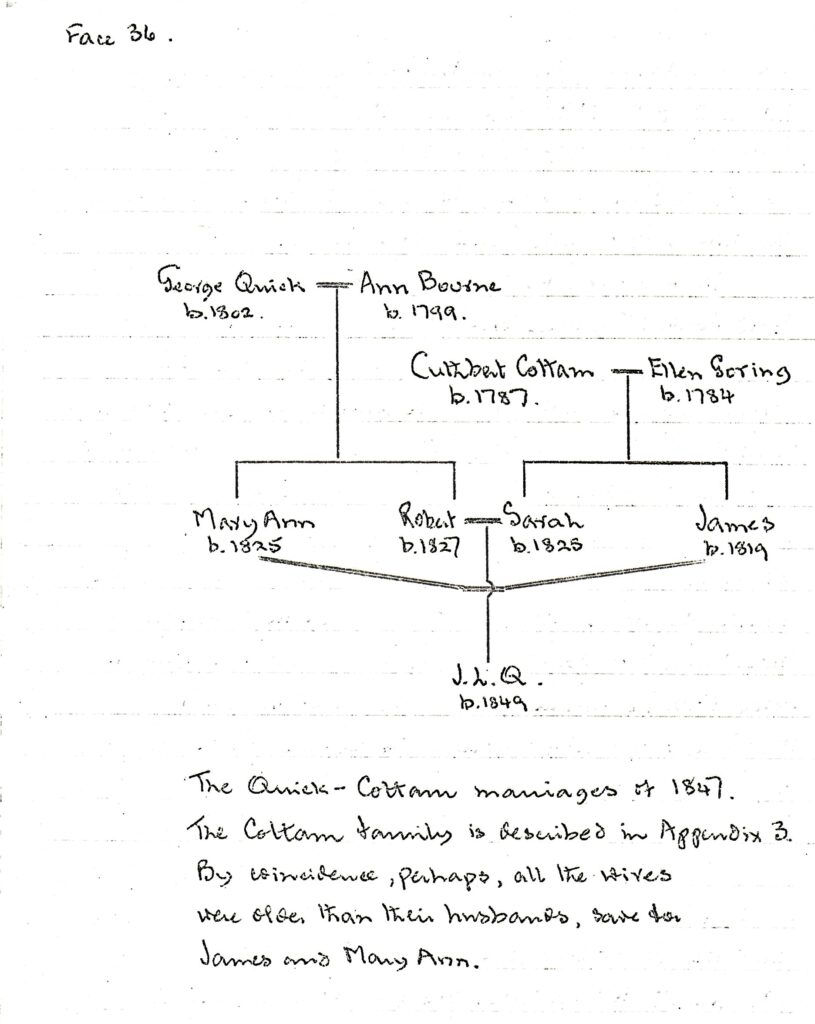
Long before he arrived there however, Blackburn had become the scene of singular domestic events. George Quick and Mary Bourne produced Mary Anne in 1825 and JLQs father, Robert, in 1827. They married a brother and sister, by names James and Sarah Cottam on the 21st of October 1847 at St Albans Church in Blackburn with the Reverend Father Nugent presiding. Another child, Thomas, born in 1836 evidently became a priest. Three years later came Eliza who became the godmother to Robert’s ill-fated son Thomas at the age of 15. Her responsibilities lasted a mere four months. She went on to marry one Henry Taylor and passed into the limbo of JLQs distant relatives.
George Quick survived his wife by 11 years and died on the 19th of June. 1883. Much more could easily be discovered about him and his influence upon JLQ. but from the historical point of view, George’s religious associations are of great importance. So was his decision to seek his fortune in Blackburn, for it was there that Quick and Cottam met and from that encounter, JLQ derived his proud boast that he was descended from the Lancashire martyrs. But the Quicks were not Blackburn people, and we must return to Merseyside, where George was born to trace their deeper origins.

The higher reaches of the Quick pedigree undoubtedly string together known members of the family from early dates and JLQ may have concentrated too much upon the Quicks of Woolton Magna to the exclusion of the others in adjoining parts of Liverpool and its environs, as a sketch will show. However, there is no reason to doubt that the John Quick baptised at Walton St Mary on the 29th of August 1779 was the father of George. The nearest contenders of John, son of Robert and Margaret, September 1763 (too early) and John, son of Thomas and Mary, June 1796 (too late). The correct John was born not in Walton Magna, but in Speke. His record runs “Baptism: John Quick Roberti et Mairae Quick in Speak filiu 26 hujus naum; Sponsores Richardus Quick et Jana Duarihouse”. This is precisely the entry recorded by JLQ. Indeed, the documentation of the whole of Johns’ generation, two brothers and four sisters, is detailed in the baptismal register at Woolton St. Mary, which must have been JLQs’ primary source.
Nonetheless, it is with John that the first of our difficulties arises, because there is no record of his marriage to Mary Molyneux. (Later, it was found at Liverpool St. Peter. “11th November 1799. John Quick (x) of the parish of Liverpool, labourer and Mary Mullyneux of the same parish spinster by Banns”. Witnesses Francis Webster and Wm. Morgan).
Unfortunately, the records of marriages at Woolton St. Mary from1781 to 1801 are missing and although it is likely that the Quick entry is among them, it is the fact that Mary Molyneux’ baptism is not recorded at Woolton at all. Considering the part played by the Molyneux’ in establishing the Woolton mission, this is surprising. So, for the time being, the Molyneux connection rests upon the strength of family tradition alone.
The marriage of Robert and Mary, John’s parents, is not recorded at Woolton, and if JLQ looked towards Woolton records as his only source, then it is at this point that his youngest grandson begins to part company with him. Robert and Mary lived in Speke, a township of the Anglican parish of Childwall, their marriage is recorded in the Childwall registers as follows !) July 1769. Robert Quick and Mary Rigby both of Speke in this parish were married by publication!. Like many other catholic of that period, they hedged their bets. their son Richard who, according to JLQ, married a devout R.C. “lies under a block of granite in the Anglican graveyard at Childwall!”
JLQ’s next two generations are the names of two Quicks living before Robert’s time, namely Richard, born around 1713, and Robert born around 1683. Moreover JLQ states that Robert, father of John, was born about 1754, was in fact, born not later than 1750.
In selecting Richard for the father of Robert(father of John) JLQ leant heavily upon the registers at Woolton St. Mary. Thanks to the Molyneux (of traditional association) the mission at Woolton began about 1715,but there is nothing in the registers there before 1756. In fact the first entry in the baptismal register at Woolton is a daughter of Richard, “born about 1713” and runs as follows: “An:1756 die 11 Januarij bapv; Eliz Quick filia Richard et Eliz: Quick, nata 5 hujus mensis: patrinus Paulus Brookfield, matrina Eliz: Rogerson.” JLQs entry is a direct copy, save that he gives the birth-date as the 4th January rather than the 5th. The entry for Richard’s son Richard, born in 1758, is also to be found. But there is no mention of his son Robert. Yet JLQ not only attaches Robert to Richard, born about 1713, but throws in Anna as well, for good measure. Anna’s marriage at Woolton is recorded thus: “Die 26 (Junij 1763) conj: in Matr: Timot : Denet et Anna Quick” The JLQ hypothesis which includes “Richard of Woolton Magna 1652” can now be subject to examination.
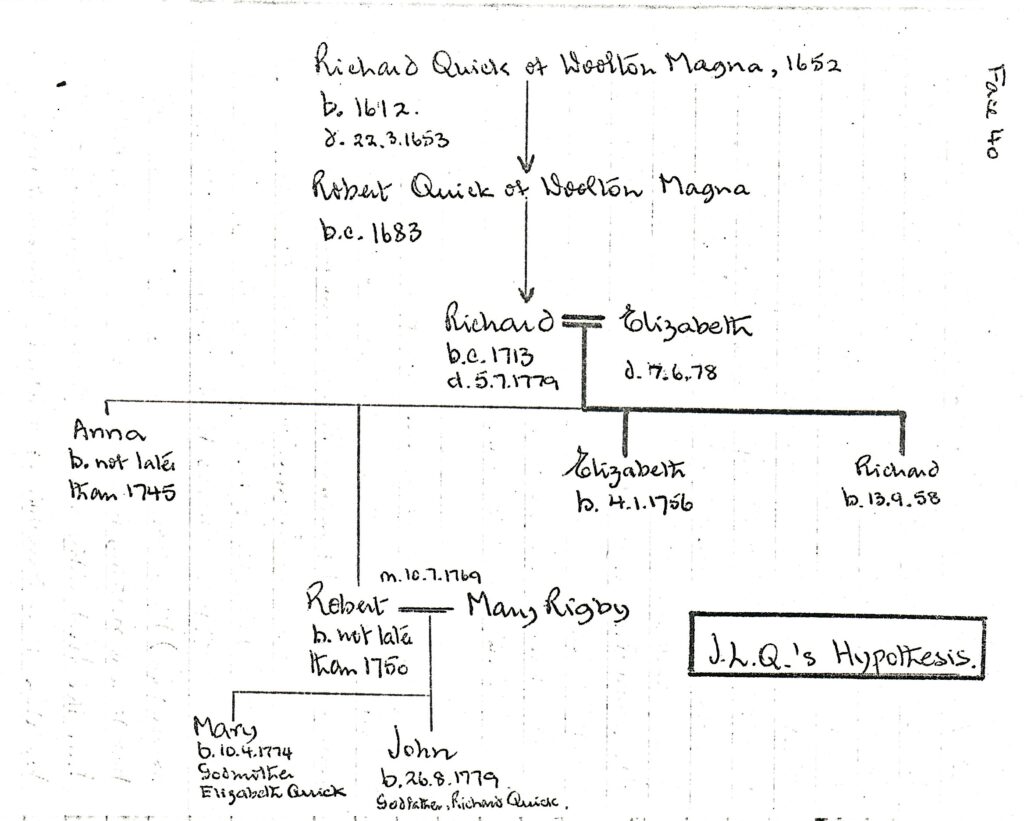
It seems very likely that Richard and Elizabeth were devout Catholics and that any children born to them before 1756 would not have been baptised other than in the Catholic mission at Woolton. Moreover, if their daughter Elizabeth was born when Richard was over 40 years old, they were unlikely to be newly married at that time and could certainly be of an age suitable for the parentage of Robert. I have no idea why JLQ included Anna in this part of the pedigree, other than through a tradition which is now lost. Two indirect pieces of evidence support the hypothesis.